
The Indian economy is expected to be "a little weaker" in 2025 despite steady global growth, IMF managing director Kristalina Georgieva has said. Georgieva also said she expects quite a lot of uncertainty in the world this year mainly around the trade policy of the US. In her annual media roundtable with a group of reporters on Friday, she said global growth is expected to be steady in 2025, but with regional divergence.

Concerns over weakening demand for Indian pharmaceutical (pharma) drugs in the US - their largest export market - have weighed heavily on investor sentiment this year. While the Nifty 50 has gained 6.02 per cent year - to - date (as on September 15), the Nifty Pharma index has declined 5.18 per cent, National Stock Exchange data shows.

Merchandise exports to the US jumped 23.5 per cent year-on-year (Y-o-Y) to $8.3 billion in June, even as India's overall outbound shipments witnessed contraction during the month, according to the data released by the commerce department on Tuesday. The increase in outbound shipments to the US was largely driven by the rush among exporters to utilise America's pause on its plans to impose country-specific reciprocal tariffs.

Qcom alone is expected to account for a 60 per cent surge in gig hiring, adding 1.5 million to 2 million roles.
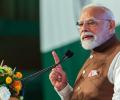
Prime Minister Narendra Modi on Friday said it is important for India and China to work together to bring stability to the world economic order as he asserted that New Delhi is ready to advance bilateral ties from a strategic and long-term perspective based on mutual respect, mutual interest and mutual sensitivity.

Though the oldest Alphas are just turning 15 in 2025, they're already more digitally fluent than any generation before, points out Sandeep Goyal.

'Not paying workers enough will end up being self-destructive or harmful for the corporate sector itself.'

The US retaliatory tariffs are a major setback for the Indian gems and jewellery exports, apex industry body GJEPC said on Thursday as it urged the government to take steps to secure the long-term interest of the sector. The US has announced 27 per cent reciprocal tariffs on India saying New Delhi imposes high import duties on American goods, as the Donald Trump administration aims to reduce US' trade deficit and boost manufacturing.

Since India relies heavily on specialised imported fasteners for critical applications in industries, such as automobiles, aerospace, electronics, and defence, their sudden unavailability will jeopardise production.

The autonomous satellite swarm is being designed for the Defence Space Agency.

'India needs at least 70,000 to 80,000 eyewear stores; our 2,000 stores are just a drop in the ocean.'

The automobile industry has sought government support in expediting approvals from the Chinese government for importing rare earth magnets used in various applications, including passenger cars. As per the industry sources, various domestic suppliers have already sought approval from the Chinese government through their local vendors in China.

'In the luxury car segment, the adoption of EVs is almost double compared to the mass market.'

If pharmaceutical exports from India to the US come under a 25 per cent tariff bracket, the impact on earnings before interest, tax, depreciation and amortisation (Ebitda) could be around 5 per cent, felt analysts. This is after assuming that about 75 per cent of the tariff would be passed on.

The escalation in the US-China trade war is expected to help India increase its exports and attract investments from American companies, think tank GTRI said on Friday. He said that last month, the US Senate introduced two bills that could intensify the trade war and have major global economic impacts if passed.

Prices for Indian consumers are expected to come down significantly from the current Rs 17,000-Rs 26,000 monthly.

Tightening Russian gas supplies to Europe has led to scramble for tankers before winter sets in.
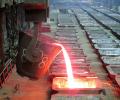
In a significant move to enhance its strategic resource security, India has officially released its first-ever critical minerals list, identifying 30 key critical minerals crucial to the nation's economic growth and technological development. This pioneering step aims at reducing import dependence, enhancing supply-chain resilience, and supporting the country's net-zero objectives. Union Minister Parliamentary Affairs, Coal and Mines Pralhad Joshi, while releasing the Critical Minerals for India report in New Delhi on Wednesday, said, "India is readying for an Atmanirbhar Bharat."

'Employers increasingly want candidates who can take AI pilots from proof-of-concept to production-ready systems.' 'That requires governance, monitoring, and ROI measurement -- skills that go beyond coding and into business impact.'

'The coronavirus epidemic highlights the need to start thinking more actively about multilateral coordination, including, but not confined to, health emergencies and climate uncertainties,' says Rathin Roy.

The era where nations thrived through rigid alignments is giving way to an age where the connective State defines power. For India, that era has arrived, points out Dr Nishakant Ojha.

The MiG-21 episode demonstrates that procurement is always strategic.
Choices about what aircraft to acquire, who builds them, who supplies the spares, who trains the pilots and technicians are decisions with political consequences lasting for decades.

'There are times when India should stand up without hesitation and voice its indignation over the US' pressure tactic. This is one such moment,' asserts Ambassador M K Bhadrakumar.

Modi called business communities and governments to work together to ensure usage of ethical AI as "we have to sense the potential disruptions in different sectors. This problem has to be solved under the global framework."

Given the high priority accorded to the manufacturing sector, several policy initiatives around the theme of Atmanirbhar Bharat have been set in motion to address its competitiveness and growth. Some notable examples include the PLI scheme and the employment-linked incentive scheme announced in the recent Union Budget. The Budget also announced the setting up of 12 industrial parks under the National Industrial Corridor Development Programme (NICDP).
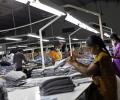
In the shadows of a sliding rupee, India's knitwear hub Tiruppur is weaving a success story. While the domestic currency edges closer to the 86 mark against the US dollar, triggering concerns for many sectors, this textile town in Tamil Nadu is finding opportunity in adversity: Between April and December alone, Tiruppur's exports reached Rs 26,000 crore, almost eclipsing last financial year's total of Rs 30,690 crore.

With the rapid evolution of channels like quick-commerce and the emergence of ONDC, the Indian retail industry is 'cautiously optimistic' for 2025, in which new-age technologies such as AI and automation will play a crucial role, driving efficiency and personalisation.

Office space owners are looking at good times ahead as rentals are expected to rise due to demand for Grade A office spaces outpacing supply that has been sluggish due to construction delays, long gestation periods and developers' interests shifting to residential.

N Chandrasekaran, chairman of Tata Consumer Products, has said in the company's annual report for FY25 that India remains one of the bright spots of economic growth amid a volatile global environment. He said India's long-term growth was underpinned by strong demographic and economic fundamentals as well as structural reforms.

Anticipating US action on tariffs, India seems to have made the first move by revamping its tariff structure by reducing the slabs to eight rates, points out Mukesh Butani.

'The US slump could hit our hosiery market hard since 40 per cent of our exports go there.' 'Job losses could be severe if the government doesn't step in fast.'

Commerce and Industry Minister Piyush Goyal on Tuesday expressed hope that India will conclude the proposed bilateral trade agreement (BTA) with the US by the fall or November this year. He said that "a little bit" of geopolitical issues overtook the trade matters in the negotiations for the pact between the two countries.

The United Kingdom extracted USD 64.82 trillion from India over a century of colonialism between 1765 and 1900 and USD 33.8 trillion of this went to the richest 10 per cent -- enough money to carpet London in notes of 50 British pound almost four times over.

Finance Minister Nirmala Sitharaman on Saturday said India is looking for a "good" trade agreement with the US to promote economic growth and ensure smooth supply chains. She also said that amid a growing global tariff war, India will have to move "smartly" to guard against possible dumping of goods from countries that are facing higher US tariffs.

For India to transform into a high-income country with a projected gross domestic product (GDP) of $23-35 trillion, will need a sustained annual growth of 8 per cent to 10 per cent. This will be powered by India's demographic dividend, technological innovation, and sectoral transformation, according to the "India@2047: Transforming India Into A Tech-Driven Economy" report by Bain & Company and Nasscom. By 2047, the services sector is expected to contribute 60 per cent of India's GDP, while manufacturing will account for 32 per cent, both playing a pivotal role in economic expansion.

In a move that signifies a major leap for India's aerospace manufacturing capabilities, the collaboration will establish a final assembly line for the Falcon 2000 jets in Nagpur, Maharashtra.

The Indian pharmaceutical industry is likely to benefit from a major wave of patent expiries in the US, as small-molecule drugs worth $63.7 billion are expected to go off-patent between 2025-29, a 65 per cent rise over the previous five years, according to a report by Antique stock broking limited.

India must remain an integral part of the global economy if it has to grow at 9-10 per cent over the next three decades, Niti Aayog CEO Amitabh Kant said on Tuesday. Speaking at the 15th India Digital Summit, Kant said India needs to become a major global exporting nation, without that it will not be possible to become richer and create wealth for its people over the next three decades.

JV to export e-carts, aim for 10% global market share, $1 bn turnover and innovation in driverless tech.

You can't be the second-most expensive market in the world and deliver just 10 per cent EPS growth, points out Akash Prakash.
